Movie scores manipulate human emotion by utilizing tempo, frequency, and instrumentation to trigger physiological responses. Fast tempos increase heart rates during action scenes, while low-frequency minor chords induce dread, effectively mirroring the psychological state of the on-screen characters and subconsciously guiding the audience’s emotional journey.
Quick Takeaways
-
Neurological Hijacking: Film scores bypass conscious thought, sending signals directly to the amygdala to trigger raw physiological responses.
-
The Shepard Tone Illusion: Composers use auditory illusions to create a feeling of endlessly escalating tension without increasing volume or pitch.
-
Infrasound and Dread: Frequencies below 20 Hz, often unfelt by the human ear, induce anxiety and physical discomfort in horror and thriller scores.
-
Entrainment: The human heart naturally syncs its beat to the tempo of a film’s rhythm, allowing composers to literally control audience heart rates.
The Invisible Puppeteer: Sound vs. Sight
Watch the shower scene in Alfred Hitchcock’s Psycho on mute. The visual of a shadowy figure with a knife is unsettling, but it lacks visceral terror. Now, turn the volume up. Bernard Herrmann’s screeching violins mimic human screams, immediately spiking your cortisol levels.
Audiences prioritize visual information, but human neurology reacts faster to sound. Auditory processing takes roughly 0.05 seconds, while visual processing takes 0.2 seconds. Before you consciously register the shark fin in Jaws, John Williams’ accelerating, heavy brass tempo has already triggered a fight-or-flight response.
This is the core of how movie soundtracks affect emotion. It is not magic; it is applied psychoacoustics.
The Science of Audio-Psychology: A Data-Backed Breakdown
Pitchfork and standard entertainment reviews often describe music as “moody” or “uplifting.” But to truly understand cinematic scoring, we must examine the biological metrics of sound processing. When we study the , the data reveals a mechanical relationship between sound waves and human neurochemistry.
Nonlinear Acoustics and the Distress Instinct
Human ears evolved to detect danger. Nonlinear acoustics—sounds that exceed the normal capacity of a vocal cord or instrument, resulting in audio distortion or raspiness—mimic the distress calls of baby animals or the roar of predators.
When a composer pushes a brass instrument to its breaking point or uses a synthesizer to create jagged, clipping waveforms, the human brain registers this as an evolutionary threat. The auditory cortex sends an immediate distress signal to the amygdala. This releases adrenaline and cortisol. The dread you feel during the brutalist, distorted synthesizer score of Annihilation or the blaring horns in Inception is a biological reflex, not a subjective interpretation.
Infrasound and the Architecture of Fear
Frequencies below 20 Hertz (Hz) fall outside the standard range of human hearing, but the human body still processes them as physical vibrations. This phenomenon, known as infrasound, creates a profound sense of unease, sorrow, or dread.
Studies in resonant frequency indicate that 18.98 Hz is the exact frequency at which the human eyeball begins to subtly vibrate, causing optical illusions and a deep sense of dread. Composers like Hans Zimmer and Hildur Guðnadóttir (in Chernobyl) utilize extreme low-frequency sub-bass to saturate the theater. You do not hear the dread; you feel it in your chest cavity.
If you want to understand the complete history of synthesizer film scores, you will find that the introduction of sub-oscillators changed horror cinema forever, allowing sound designers to weaponize invisible frequencies.
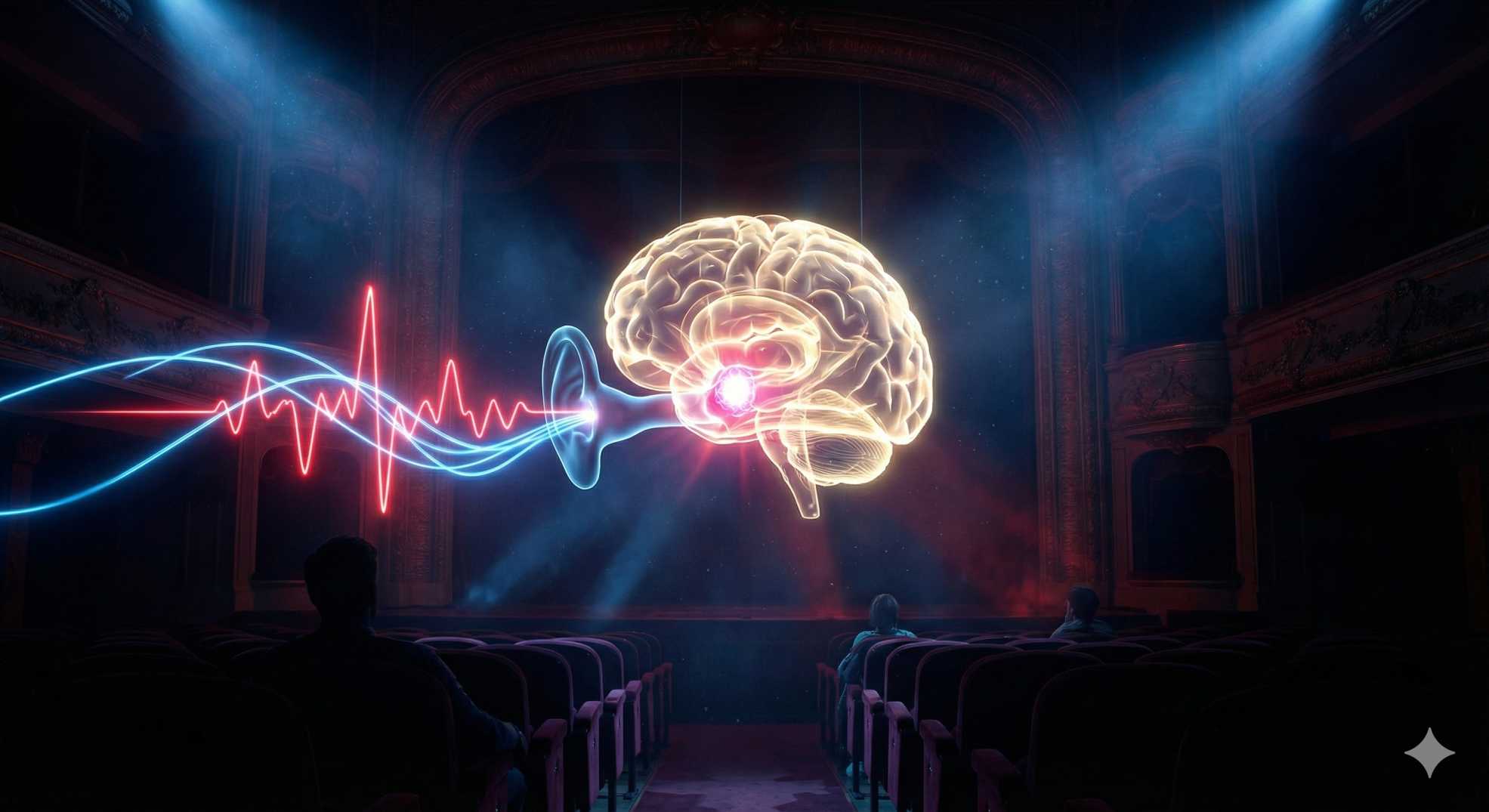
Heart Rate Entrainment and Tempo Manipulation
Entrainment is a biomusicological concept where a listener’s biological rhythms—specifically breathing and heart rate—naturally synchronize with an external rhythm.
When a director wants to induce panic, the composer sets a track to 120-140 beats per minute (BPM), mimicking a resting heart rate accelerating into tachycardia. Conversely, sweeping romantic epics utilize tempos resting comfortably at 60-70 BPM, simulating a relaxed, parasympathetic nervous system state.
The Shepard Tone: Infinite Tension
Christopher Nolan’s Dunkirk is a masterclass in psychological manipulation via sound. To simulate the relentless, claustrophobic anxiety of survival, Hans Zimmer utilized a Shepard Tone. .
A Shepard Tone is an auditory illusion created by stacking distinct tones separated by octaves. As the highest pitch gets quieter, the middle pitch remains stable, and the lowest pitch gets louder. The brain perceives a tone that is constantly ascending in pitch but never actually gets any higher. Paired with a relentless ticking clock (recorded from Nolan’s own pocket watch), the score holds the audience in a state of suspended, unending physiological tension.
For a deeper dive into this specific technique, read our comprehensive guide on analyzing Hans Zimmer’s signature sound.
The Anatomy of Frequency, Harmony, and Timbre
Why does a lone piano make audiences feel melancholic, while a distorted electric guitar makes them feel defiant? It comes down to the structural properties of the music itself.
Dissonance vs. Consonance
Consonant chords feature sound waves that fit mathematically together without friction. They signal resolution, safety, and triumph. Dissonance occurs when frequencies clash mathematically, creating a “beating” effect that the brain finds inherently unstable. Composers use unresolved dissonant chords to signify that a character’s journey is incomplete or that danger is lurking.
The Impact of Timbre
Timbre is the unique texture or “color” of a sound. A middle C played on a violin sounds vastly different from a middle C played on a flute.
-
Strings: Sweeping orchestral strings mimic the cadence and prosody of the human voice, triggering empathy and sorrow. Scraping or plucking strings (pizzicato) triggers alertness.
-
Brass: Historically associated with military calls, heavy brass sections trigger feelings of authority, doom, or heroism.
-
Woodwinds: Soft and airy, woodwinds are often used to signify innocence, isolation, or the natural world.
<aside>
Data Breakdown: The Physiology of Cinematic Audio
The Leitmotif: Anchoring Memory and Emotion
While frequencies manipulate raw physiology, melodies manipulate memory. The Leitmotif—a term popularized by Richard Wagner and perfected in modern cinema by John Williams—is a recurring musical phrase associated with a specific character, place, or idea.
Leitmotifs operate on the psychological principle of classical conditioning (Pavlovian response). By repeatedly pairing a specific melody with a specific visual stimulus (e.g., the Imperial March with Darth Vader), the composer hardwires a mental association in the audience’s brain.
Eventually, the composer can trigger the emotional weight of a character’s presence without the character ever appearing on screen. If a faint, minor-key version of the hero’s theme plays, the audience instantly feels a sense of loss or defeat. This demonstrates the difference between mere background music and structural storytelling. To see how this evolved over the decades, explore the evolution of the cinematic leitmotif.
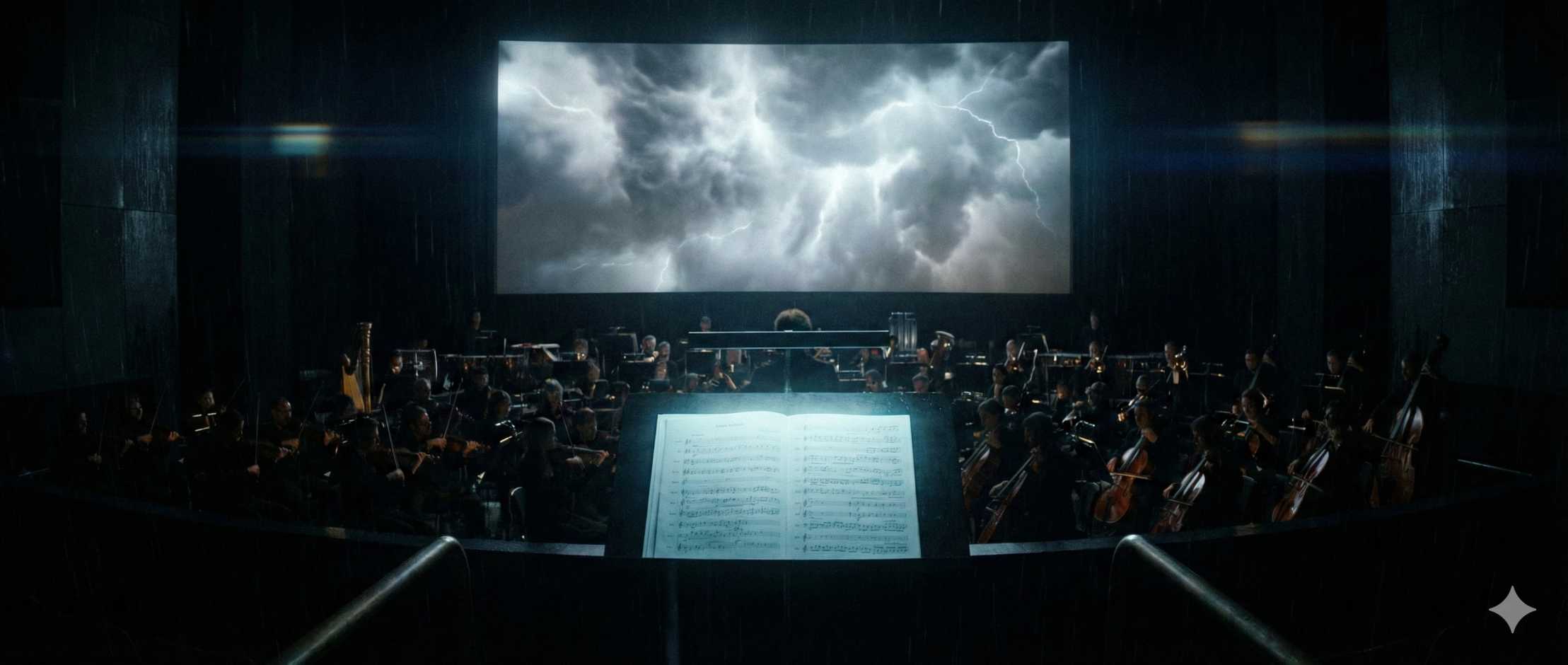
A dark orchestra pit playing a dramatic movie score in front of a cinema screen.
Silence as the Ultimate Frequency
Just as how sound design differs from musical scoring is crucial to a film’s impact, the absolute absence of sound is a composer’s most lethal weapon.
In a medium where audiences are constantly bombarded by auditory stimuli, sudden absolute silence creates an auditory vacuum. The sudden removal of background noise forces the audience to lean forward, becoming hyper-aware of their own breathing and the rustling in the theater. By denying the audience the emotional cue they expect from the score, the composer forces them to confront the raw reality of the on-screen action.
The Final Frame
Understanding how movie soundtracks affect emotion bridges the gap between art and neuroscience. Film composers are not just musicians; they are psychological architects. By wielding tempo to hijack our heart rates, dissonance to trigger our evolutionary distress signals, and infrasound to rattle our ribcages, they ensure that we do not just watch a movie—we survive it.
Frequently Asked Questions (FAQ)
1. What frequency causes fear in movies? Frequencies around 18 to 19 Hz, known as infrasound, are heavily associated with fear and dread. Because they sit just below the threshold of human hearing, they are felt as vibrations in the chest and eyes, causing biological unease without an identifiable audio source.
2. How does tempo affect the audience’s heart rate? Through a biological process called entrainment, the human autonomic nervous system naturally attempts to synchronize breathing and heart rate with dominant external rhythms. Fast tempos (120+ BPM) force the heart rate up, simulating panic or excitement.
3. What is a Shepard Tone? A Shepard Tone is an auditory illusion created by layering distinct tones separated by octaves. As tones fade in and out at different pitches, the brain perceives a single sound that is endlessly rising in pitch, creating a feeling of infinite, unresolving tension.
4. Why do minor keys sound sad or scary? Minor keys utilize intervals that create slight mathematical dissonance in the sound waves. The human brain perceives this subtle harmonic friction as unstable or unresolved, which psychological conditioning associates with sadness, danger, or mystery.
5. What is the difference between a film score and a soundtrack? A film score is the original, instrumental music composed specifically for a film to drive the narrative and emotional arcs. A soundtrack typically refers to a curated collection of pre-existing commercial songs (with lyrics) that are licensed for use in the movie.